

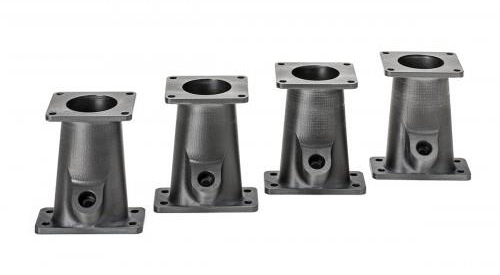
A 3D-printed fuel intake runner fabricated from a reinforced grade of Solvay’s KetaSpire polyetheretherketone (PEEK) will reportedly be featured in the Polimotor 2 project, spearheaded by Matti Holtzberg. Arebo Labs manufactured the part utilizing its highly advanced Reinforced Filament Fusion technology. The technical project targets to design and produce a next-generation, all-plastic engine for competitive racing next year.
Holtzberg, president of Composite Castings, revealed in a statement that the intake runners in the original Polimotor engine were made from aluminum, but today’s automotive industry fully relies on injected molded nylon. He added that the choice of materials is also changing, as carmakers seek advanced, new alternatives such as Solvay’s PEEK that can withstand rising under-the-hood temperatures caused by the increasing use of turbochargers and engine downsizing, both of which result in higher specific power outputs.
When the original aluminum runner was replaced with PEEK, the part’s weight reduced to 50 percent. The material selected for Polimotor 2 was a custom-formulated grade of KetaSpire KT-820 PEEK secured by a 10 percent carbon fiber loading. KetaSpire PEEK provides automotive fuels with outstanding chemical resistance, as well as highly reliable mechanical performance at temperatures up to 240°C (464°F). These unique characteristics made the PEEK an ideally suitable candidate for Polimotor 2’s fuel intake runner, which encounters temperatures up to 150°C (302°F) near the pistons in the intake port. Thanks to Arevo’s Reinforced Filament Fusion platform that enables printing with reinforced PEEK polymers. Used in conjunction with Arevo’s process control software, the platform can help enhance the mechanical properties of printed parts.
Brian Baleno, global automotive business manager for Solvay Specialty Polymers, noted that the convergence of 3D printing with Solvay’s PEEK polymer technology in this application highlights how cutting-edge the Polimotor 2 project is. “Neither of these technologies existed in the ’80s when Matti Holtzberg developed the first Polimotor engine; and now, with this runner, we see one of the very first carbon fiber-filled PEEK parts to be fabricated with the additive manufacturing process. That signals a whole new range of possibilities for automakers seeking lighter, but high-performing alternatives to metal.”