

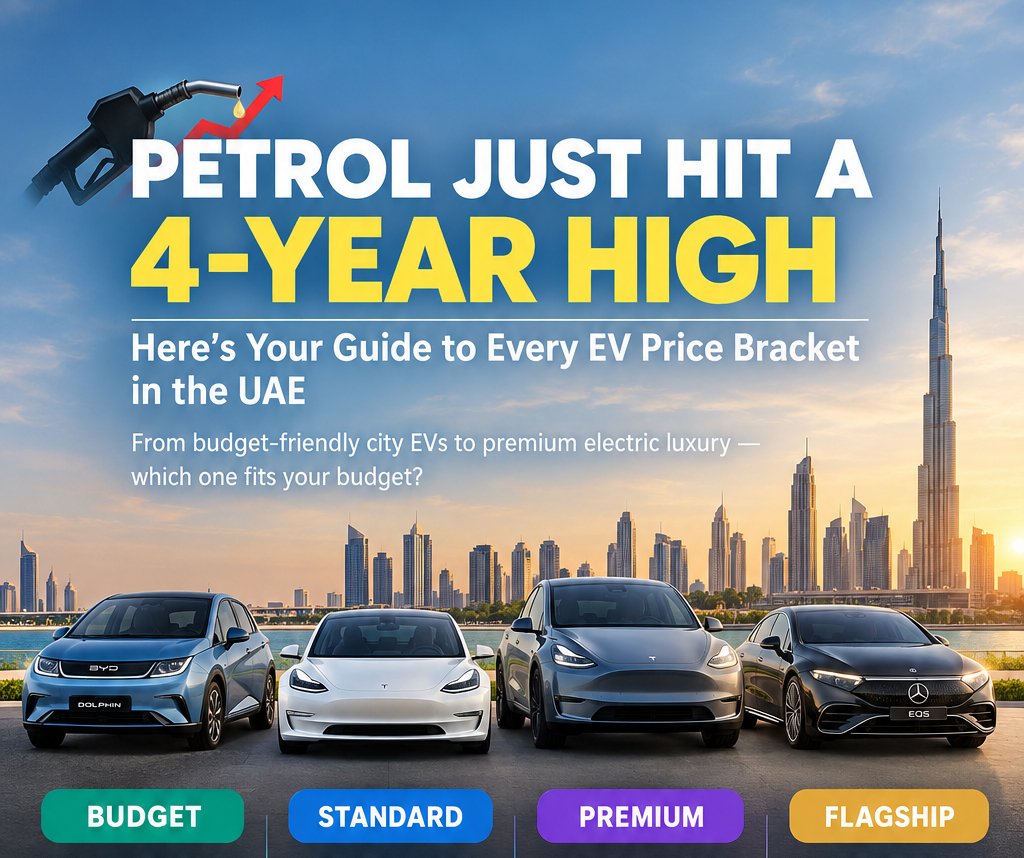
UAE petrol prices crossed AED 4 per litre in October 2026 for only the second time in the country’s history, with Super 98 up 16.6% in a single month amid regional oil-market volatility. For drivers weighing their next car purchase, electric vehicles are no longer a single, expensive category — there’s now a genuine option at almost every budget, and even Porsche, one of the most followed brands in the UAE, has now gone fully electric with its best-selling SUV. Here’s the full breakdown, by price tier.
Why this matters right now
UAE fuel prices rose for a third straight month in October 2026, with Super 98 climbing to AED 4.40 a litre, Special 95 to AED 4.28, and E-Plus 91 to AED 4.21, increases of nearly 16.6% in a single month. Diesel rose to AED 4.80. These are the highest petrol prices the UAE has recorded since July 2022, driven by Brent crude nearing $110 a barrel amid ongoing US-Iran tensions and uncertainty around the Strait of Hormuz. Fuel costs are now roughly 80% higher than they were back in February.
At the same time, running an EV in the UAE has become measurably cheaper than it was even a year or two ago, both in terms of purchase price and cost per kilometre, with Chinese brands driving much of that shift at the entry level, and legacy performance brands now arriving at the top. In fact, by Q1 2026, BYD had overtaken Tesla to become the best-selling EV brand in the UAE.
The Porsche angle: a brand UAE drivers already love, now going electric
Porsche has one of the most loyal followings of any car brand in the UAE, backed by a packed regional calendar, including the Porsche Carrera Cup Middle East at Dubai Autodrome and the annual Icons of Porsche festival, which returns to a new venue at The Square, Nad Al Sheba, Dubai, on 21–22 November 2026. More than 30,000 enthusiasts attended last year’s edition, making it the largest automotive festival in the region.
The bigger story for this article: Porsche has now launched the Cayenne Electric, a fully electric version of its best-selling SUV, which made its public Middle East debut in Dubai. In the UAE, it starts at roughly AED 412,700 for the base Electric trim and rises to about AED 635,000 for the Turbo Electric, which produces up to 1,156 PS. It runs on a 113 kWh battery with an 800V architecture, officially rated at up to 642 km WLTP range, with real-world UAE highway range estimated at 500 to 560 km accounting for heat and AC use. Deliveries through official Porsche Centres in Dubai and Abu Dhabi are expected through the second half of 2026.
For a brand with this much local following, an electric Cayenne lowers the barrier to EV ownership for existing Porsche buyers in a way that matters more than price alone, it’s a familiar badge, now available without a drop of petrol.
The real running-cost gap
Based on current DEWA and ADDC tariffs, home charging costs roughly AED 0.05 to 0.12 per kilometre, compared with roughly AED 0.28 to 0.30 per kilometre for a petrol car at today’s pump prices. Public AC charging costs more, around AED 0.12 per km, and DC fast charging more still, around AED 0.18 to 0.21 per km, but even in the least favourable charging scenario, an EV still typically costs less to run than petrol.
For a driver covering 20,000 to 30,000 km a year, home charging alone can save roughly AED 5,000 to 7,000 annually versus petrol at today’s prices. EV owners in the UAE also typically see 30 to 40% lower annual maintenance costs, although EV insurance currently runs 20 to 35% higher than for an equivalent petrol car, and Chinese-brand EVs specifically tend to sit at the higher end of that insurance range, so it’s worth factoring in before buying.
Tier 1: Budget EVs — Under AED 100,000
This is where the UAE market has changed the most, and Chinese automakers are driving nearly all of it. Three years ago, the entry price for a new EV was around AED 130,000. Today it’s well under that mark, and the list of options keeps growing.
- BYD Seagull — from roughly AED 42,000–55,000, up to 405 km range. Currently the cheapest usable, officially sold new EV in the UAE.
- JAC E30X — from AED 61,900, 400 km WLTP range, 1.5-hour DC fast charging.
- BYD Qin Plus EV — from AED 74,900, an electric sedan with a long-range option, frequently cited as one of the best-value EVs in this bracket.
- Geely Galaxy E5 — from roughly AED 58,000–70,000.
- GAC Aion ES — from AED 79,900, distributed in the UAE by AGMC.
- Chevrolet Spark EUV — from AED 79,900, a joint-venture EV built with SGMW in China.
- Wuling Bingo (Binguo) — under AED 55,000, a compact city EV from the SAIC-GM-Wuling joint venture, popular in China and increasingly available regionally.
Best for: first-time EV buyers, city commuting, and anyone switching away from a budget petrol hatchback for the first time. This is also the segment where Chinese brands most clearly undercut Japanese and Korean petrol rivals, not just other EVs, on price.
Tier 2: Standard / Mid-Range EVs — AED 100,000 to 250,000
This is the broadest and fastest-growing segment, where most mainstream EV buyers in the UAE are currently shopping, and where Chinese and Western brands now compete directly.
- MG4 EV — from roughly AED 102,000–138,000.
- MG ZS EV — from roughly AED 115,000, one of the more affordable electric SUVs.
- BYD ATTO 3 — from AED 109,900.
- XPENG G9 — from AED 227,934.
- Volkswagen ID.4 — from roughly AED 140,000–200,000, 480 km range.
- Hyundai IONIQ 5 — from roughly AED 153,000–163,000.
- Tesla Model 3 — from AED 144,990–219,990, the most accessible Tesla in the UAE.
- Tesla Model Y — from AED 178,670–244,990, the best-selling EV in the UAE.
- Kia EV6 — from roughly AED 209,895.
Best for: families and daily commuters who want a full-size, feature-rich EV without stepping into luxury pricing.
Tier 3: Premium EVs — AED 250,000 to 500,000
This bracket covers established luxury brands building out fully electric lineups, along with performance-oriented SUVs and the first wave of premium Chinese entrants.
- Porsche Cayenne Electric (base) — from roughly AED 412,700, Porsche’s first fully electric SUV, officially rated up to 642 km WLTP range.
- NIO EL8 — from AED 359,900, one of the more established Chinese premium EV brands in the UAE.
- Tesla Model X — from roughly AED 342,990–397,990.
- Tesla Model S — from roughly AED 320,000–580,000.
- Mercedes-Benz EQE — from AED 358,900.
- Jaguar I-Pace — from roughly AED 368,550–446,355.
- GMC HUMMER EV — from roughly AED 519,000–697,000.
- Porsche Taycan (entry trims) — from roughly AED 443,900, at the lower end of this bracket.
Best for: buyers upgrading from a petrol luxury sedan or SUV who want the badge and refinement without jumping to flagship pricing. The Cayenne Electric specifically suits existing Porsche SUV owners who want to switch without sacrificing brand feel.
Tier 4: Flagship Luxury & Performance EVs — AED 500,000+
At the top of the market, EVs now go head-to-head with the most prestigious petrol models on the road.
- Mercedes-Benz EQS — from AED 537,995–802,900, the brand’s flagship electric sedan with a claimed 615 km range, the longest in its class.
- Mercedes-Benz EQS SUV — from roughly AED 554,994–652,900.
- Porsche Cayenne Electric Turbo — up to roughly AED 635,000, producing up to 1,156 PS, Porsche’s most powerful SUV yet.
- Porsche Taycan (top trims) — up to roughly AED 962,400, the sportiest option in this bracket.
- Mercedes-Benz Maybach EQS — AED 831,900, the ultra-luxury ceiling of the segment.
Best for: buyers who were always going to spend six figures on a luxury car and now have a genuine electric option at the same level of prestige.
What to tell a customer weighing the switch
With petrol now above AED 4 a litre for the first time since 2022, the maths has shifted meaningfully in favour of EVs for anyone doing real daily mileage, particularly with home charging set up. The main trade-offs worth flagging honestly:
- Higher EV insurance premiums partly offset fuel and maintenance savings, so the full annual cost comparison matters more than the per-litre headline.
- Chinese-brand EVs specifically can carry insurance premiums 20 to 35% higher than a comparable Japanese petrol car, though their purchase price is often substantially lower, so the gap usually still favours the EV overall.
- Public DC fast charging narrows the savings gap significantly compared to home charging, so a buyer without home charging access should set expectations accordingly.
- Battery replacement, while rare within typical ownership periods, can cost AED 12,000 to 20,000, and is worth checking against the battery warranty (most now run 8 years or 160,000 km).
- Resale value for newer Chinese brands is still establishing itself in the UAE compared with more established names like MG, which already has a stronger second-hand market and dealer footprint. Porsche, by contrast, has one of the strongest resale reputations of any brand in the segment, which may ease concerns for buyers considering the Cayenne Electric specifically.
Even accounting for those caveats, at today’s fuel prices an EV charged at home remains roughly five times cheaper to run per kilometre than a comparable petrol car, a gap that’s only grown wider over the past year, and the entry point for owning one has never been lower, or, at the top end, more familiar.
Sources: Khaleej Times, The National, Dubicars, YallaMotor, Oil & Gas Middle East (petrol pricing); ZigWheels, ArabWheels, CarSwitch, Dubizzle, EVLife, Shory, iCarTea, AlbaCars, DriveArabia, Porsche Newsroom (EV pricing, Porsche Cayenne Electric and running costs). Prices current as of September–October 2026 and may vary by dealer, trim and promotion.