

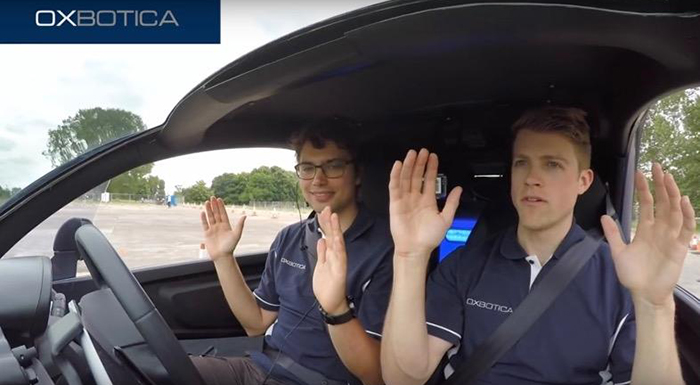
Oxbotica, a startup technology company based in Oxford, UK, has recently unveiled its mobile autonomy software Selenium. Although the developers demonstrated the software in a purpose-built concept car, they say that it can be applied to more or less any vehicle. Another factor making the software unique is that it gets its bearings without relying on GPS.
The beauty of Selenium is that it can work in pedestrianized environments as well as in motorways and roads, and is not dependent on GPS to operate. This means it can easily transition between indoor and outdoor settings as well as over ground or underground. The system has also been developed to be vehicle agnostic. In accordance with the developers, it can be applied to vehicles, self-driving pods, and warehouse truck fleets.
The revolutionary software was developed by Oxbotica’s team of mathematicians, scientists and engineers in the UK and can provide any vehicle it is applied to with awareness of its location and surroundings, and with that knowledge in hand, how it must move to complete task.
Selenium’s system utilizes patented algorithms that provide vehicles with a high level of intelligence to autonomously perform an array of mobility tasks, including braking, motion control, navigation, calibration, as well as static and dynamic obstacle detection.
The software is slated for deployment at a series of autonomy trials where Oxbotica is the only supplier of autonomy software, including the £8 million GATEway project in Greenwich and the LUTZ Pathfinder self-driving pod project in Milton Keynes. Also, the company is working with manufacturers in a wide array of mobile autonomy domains, driverless cars.