

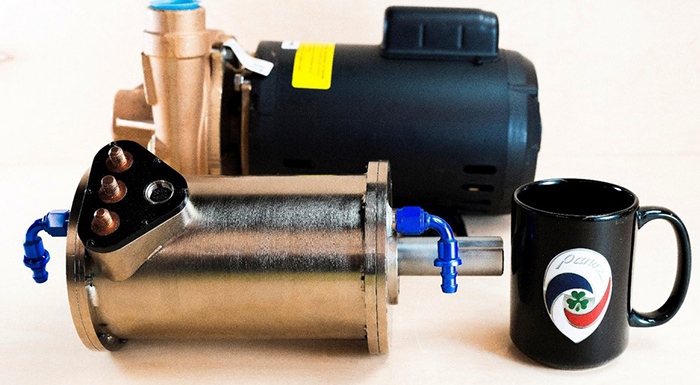
In an effort to take drivers’ and occupants’ motoring experience to new heights, DeltaWing Technology Group and DHX Electric Machines have recently collaborated to build small, lightweight electric motors. According to the companies, their motors are up to 75 percent smaller than equivalent-output motors for automotive applications made possible by engineering improvements in heat management.
It is found that much of the bulk of high-torque electric motors, such as those normally used in automotive applications for electrified vehicles, is in the heat management systems engineered into the motor casings. Efforts in reducing this bulk normally lead to loss of torque output in heavier usage. According to DHX, its design minimizes bulk by up to 75 percent without losing thermal management efficiency, thereby retaining the motor’s anticipated output in heavy usage.
In an electric motor, the windings produce most of the heat generated during use. Liquid or air cooling is typically used to dissipate this heat into the motor’s frame and case through the stator, which, unlike the windings, is fixed to those elements. In the DHX design, a heat exchanger in the winding pulls heat away more efficiently. The company calls this a Direct-Winding Heat Exchanger (DWHX), and it consists of tiny channels that are made to reduce thermal resistance by pulling heat away from the windings. This substitutes heavy liquid cooling and less efficient air cooling.
Meanwhile, DeltaWing, which rose to fame for its partnership with Nissan on the Ben Bowlby-designed racing car of the same name, will design vehicles to use the motor. The company presently manufactures the Panoz DeltaWing Racing coupe for International Motor Sports Association (IMSA) competition.
DeltaWing confirms that vehicles for development and production using the DHX motors, will include two-, three-, and four-wheeled designs ranging from scooters to urban vehicles to highway-ready EVs and delivery vehicles. The motors will be designed for use in battery electric and hybrid-electric vehicles.