

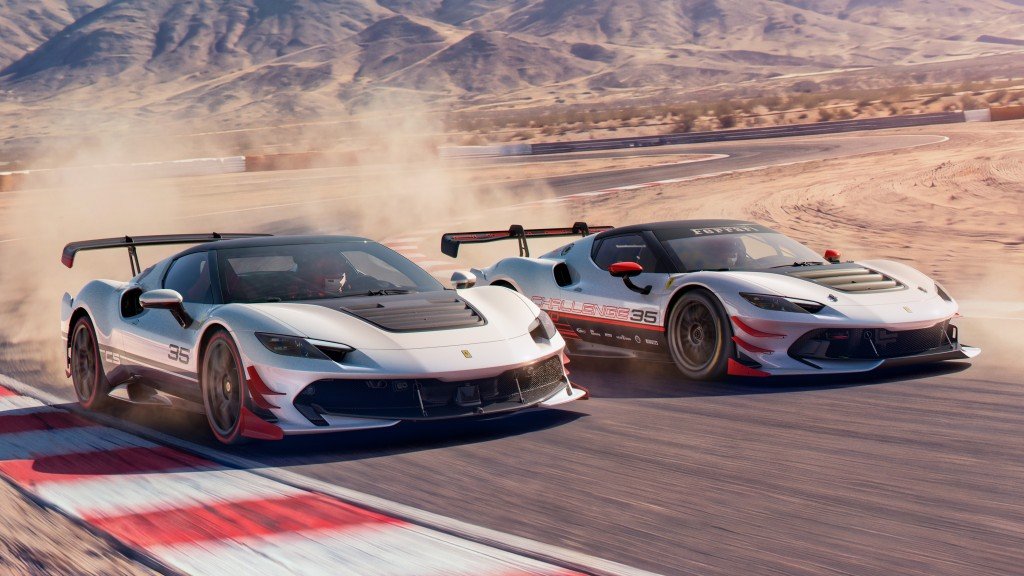
Ferrari has built a road car that behaves like a race car, and a race car to match. On 21 November 2026, at the Ferrari Finali Mondiali at the Circuit de Barcelona-Catalunya in Montmeló, Spain, the company unveiled the 296 Challenge Stradale, a road-legal car with no hybrid system, and the 296 Challenge Evo, a track-only racer for the 2027 Ferrari Challenge series. Both use the same twin-turbo V6, weigh the same, and share a single philosophy: precision and consistency over everything else. Here is everything announced.
Quick Highlights
- Revealed on 21 November 2026 at the Ferrari Finali Mondiali in Montmeló, Spain
- 296 Challenge Stradale: 670 hp, road-legal, no hybrid system, 1,330 kg dry weight, 617 kg of downforce at 250 km/h
- 296 Challenge Evo: 700 hp, track-only, debuts in the 2027 Ferrari Challenge series
- 0 to 100 km/h in 2.8 seconds and a top speed above 300 km/h for the Stradale
- Italian price reported at €291,000, about AED 1.18 million (US$320,000), but not published by Ferrari
Two Cars, One Idea
Ferrari describes the Challenge Stradale as the car in its current range with the most direct link to a race car, and the Challenge Evo as the benchmark car for the Ferrari Challenge going into 2027. They were developed together so that technology could pass between the track and the road. Both are built around a driving experience that puts precision, stability and repeatable performance first.
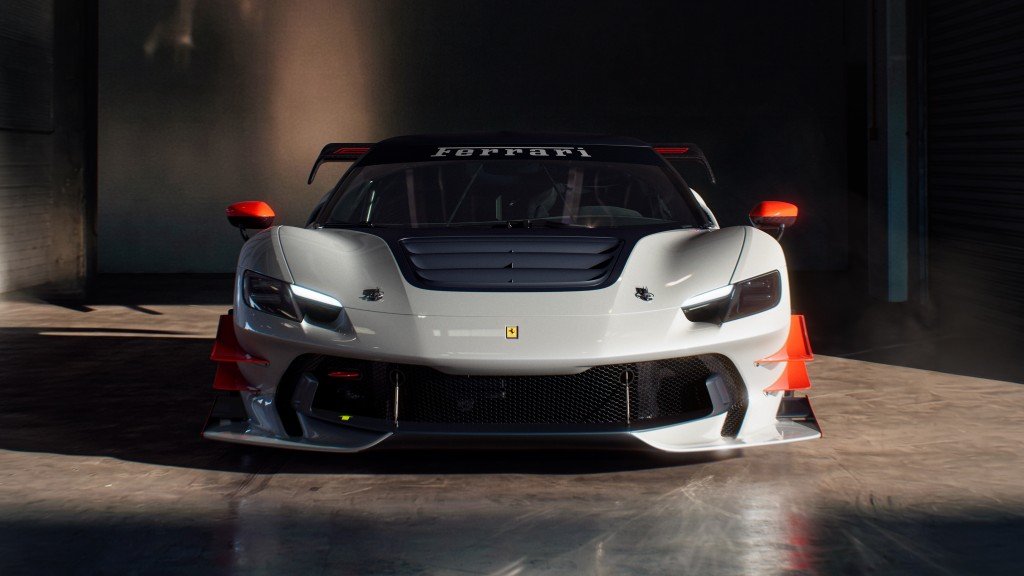
296 Challenge Stradale: The Road Car
A V6 Without Hybrid Help
The 2,992 cc, 120-degree twin-turbo V6 appears here without the plug-in hybrid system used in other 296 models. It produces 670 hp at 8,000 rpm and 740 Nm of torque at 6,250 rpm, with a redline of 8,500 rpm, and drives the rear wheels through an eight-speed dual-clutch gearbox. Ferrari quotes the figure in “cv”, which is metric horsepower, so it equals about 661 mechanical hp. Removing the hybrid system saves weight and complexity, and it gives the driver a more direct connection to the throttle and rear wheels.
The Weight Loss
Dry weight is 1,330 kg, which is 140 kg less than a 296 GTB, giving a weight-to-power ratio of 1.98 kg per hp. The savings come from removing the hybrid hardware, a dedicated driveline, lightweight components, and a racing-style cockpit. Carbon-fibre rear wing and bonnet trim, forged wheels and tubular seats all help.
Aerodynamics
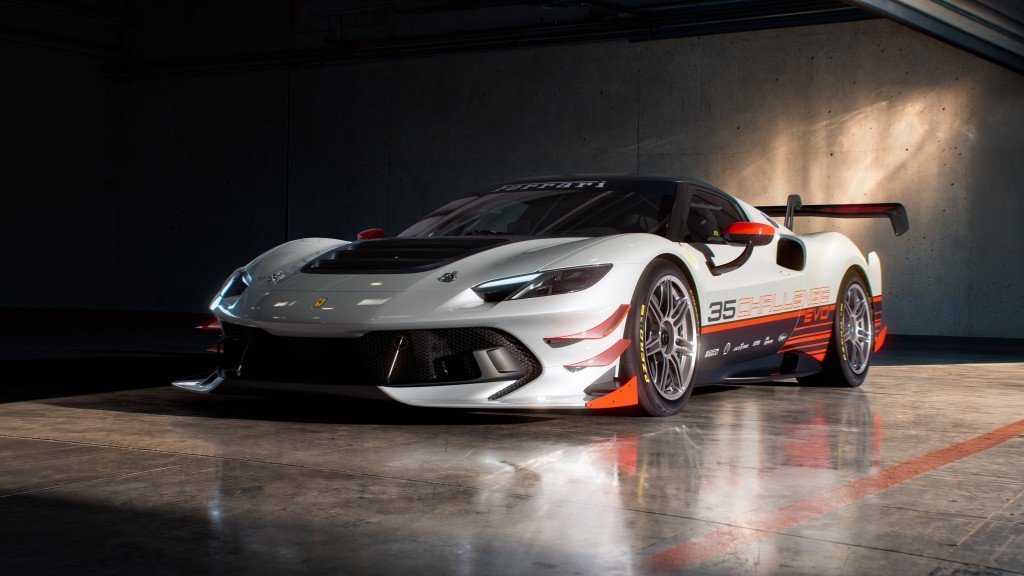
The Stradale generates 617 kg of downforce at 250 km/h, 72% more than a 296 GTB. It gets this from a fixed rear wing, a front splitter, side “flick” elements, an aero damper that makes the downforce more consistent as the car pitches, vortex generators and a fully enclosed underbody. The rear wing alone is responsible for 270 kg. Ferrari says it ran thousands of hours of computer simulation and hundreds of hours in the wind tunnel.
Handling and Brakes
- Chassis: compared with the 296 GTB, maximum lateral performance is up 7%, stability is up 34% and the roll gradient is down 68%
- Tyres: Pirelli P Zero R and P Zero Trofeo RS semi-slick tyres developed for this car, in 245/35 R20 at the front and 305/35 R20 at the rear
- Brakes: carbon-ceramic discs measuring 398 x 38 mm at the front and 380 x 34 mm at the rear, with a pedal feel that matches the Challenge Evo
- Electronics: predictive slip control and ABS Evo that works in every Manettino setting, both firsts for a Ferrari road car
Sound and Auxiliary Systems
Ferrari kept the 296’s distinctive V6 character, with a “hot tube” system that carries exhaust pressure waves into the cabin and a new twin-tailpipe exhaust. An exhaust designed purely for track use, free from road-approval limits, can be fitted and removed at official dealerships. Without the hybrid system, engineers also had to develop a mechanical air-conditioning compressor and a belt starter-generator, which is a first for a Ferrari road car.
Design and Interior
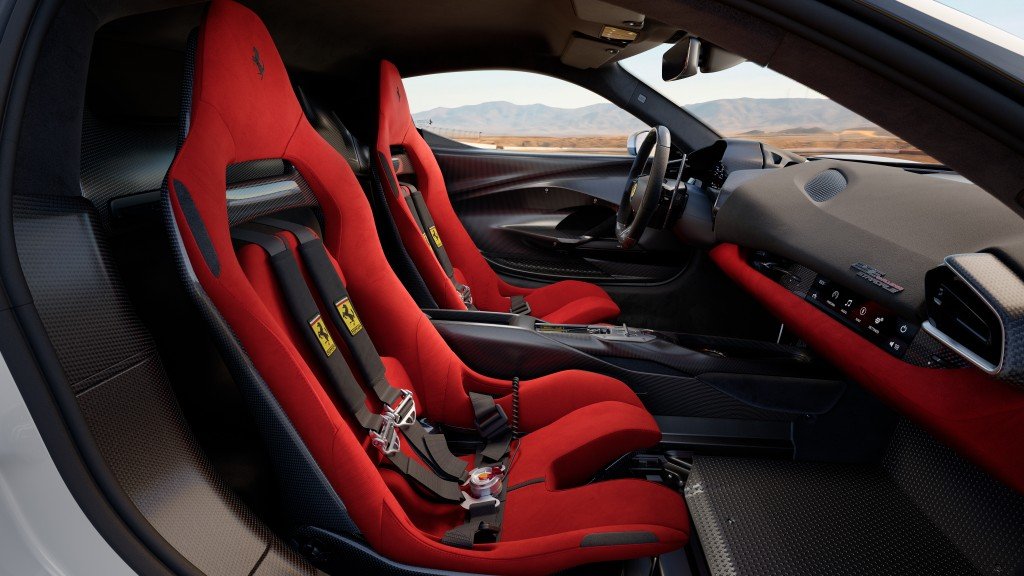
The Ferrari Design Studio, led by Flavio Manzoni, stripped away every unnecessary surface. Highlights include a large technical vent on the bonnet, a suspended front wing between two body-coloured “claws”, a fixed rear wing on hollow struts and a black mesh that leaves the exhaust tailpipes visible. Inside, the cockpit can be ordered in an extreme specification: a single carbon-fibre door panel with no armrest or storage pocket, and, for the first time on a production Ferrari, an option that leaves part of the chassis exposed under the seats and centre console.
- Options: carbon-fibre tubular seats from the SF90 XX Stradale, which Ferrari says are 25% lighter than standard racing seats, and forged wheels that cut unsprung mass by about 11.9 kg
- Customisation: a racing livery, matte wheel finishes and Alcantara in seven colours
- Cover: Ferrari’s seven-year Genuine Maintenance programme is available
296 Challenge Evo: The Race Car
The Challenge Evo is the tenth car built for the Ferrari Challenge and an evolution of the 296 Challenge, which has raced since 2024 as the series’ first V6. Its V6 makes 700 hp at 7,500 rpm, through a seven-speed gearbox, with the same 1,330 kg dry weight. Development focused on aerodynamics, vehicle dynamics and a wider operating window.
- Downforce: up 12% over the 296 Challenge, about 100 kg more at 250 km/h
- Low Drag configuration: a new setting for fast circuits that cuts drag by 4% by lowering the wing angle and removing the front aerodynamic add-ons
- Parts: carbon-fibre splitter, front bumper, rear diffuser and mirrors, plus a high-performance driveshaft with dedicated cooling
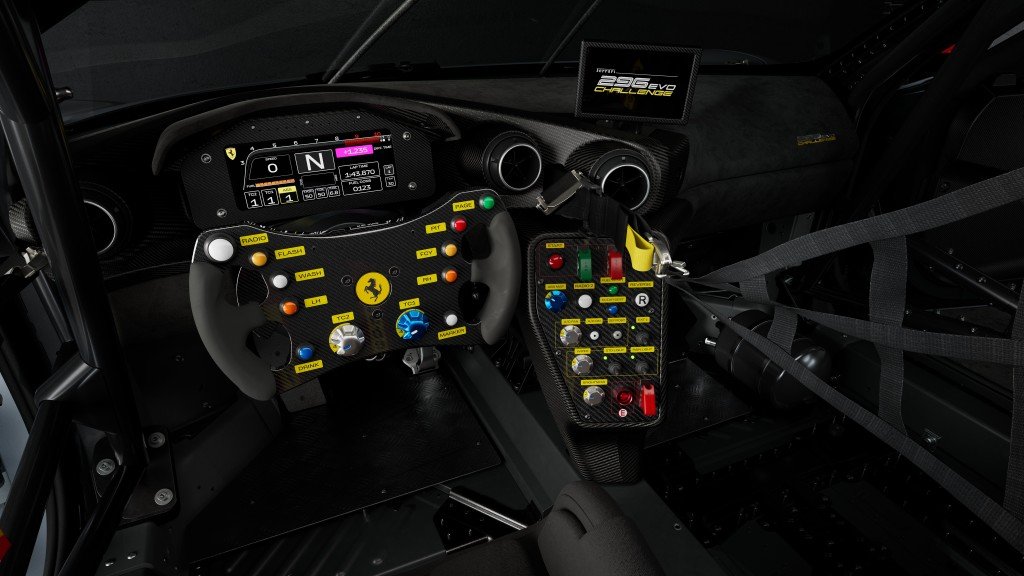
- Controls: updated traction control and electronic differential, a new brake-pedal curve and a redesigned instrument cluster
- Pace: 0.8 seconds faster per lap than the 296 Challenge at Mugello in testing
The Evo debuts in 2027 in the European and North American series, in the 35th year of the Ferrari Challenge. In 2027, the series also introduces three rounds with 40-minute endurance races, starting at the second event, at Mugello.
Side by Side
| Detail | 296 Challenge Stradale | 296 Challenge Evo |
|---|---|---|
| Use | Road-legal | Track-only race car |
| Engine | 3.0 V6 twin-turbo, no hybrid | 3.0 V6 twin-turbo, no hybrid |
| Power | 670 hp at 8,000 rpm | 700 hp at 7,500 rpm |
| Gearbox | 8-speed dual-clutch | 7-speed dual-clutch |
| Dry weight | 1,330 kg | 1,330 kg |
| Downforce | 617 kg at 250 km/h | +12% vs 296 Challenge |
| 0 to 100 km/h | 2.8 s | Not published |
| Fiorano lap | 1 min 18.5 s | Not published |
| Debut | Orders and deliveries from 2027 | 2027 Ferrari Challenge season |
The Stradale also reaches 200 km/h from a standing start in 7.9 seconds and brakes from 200 km/h to a stop in 101 metres. Its top speed is above 300 km/h, and its length is 4,678 mm with a 2,600 mm wheelbase.
Price and Availability
Ferrari has not published a price in its announcement. Italian business daily Il Sole 24 ORE reports a price of €291,000 in Italy for the Challenge Stradale, a thousand euros less than a 296 GTB, because the hybrid hardware and some comfort features were removed. Other outlets put that at about US$320,000, roughly AED 1.18 million, and expect US deliveries around the middle of 2027. They also report that the Stradale is a standard-range model, not a limited series, though Ferrari’s release gives no production numbers. The Evo, a track-only car, is reported at close to US$400,000, about AED 1.47 million, with deliveries starting in the first quarter of 2027.
These are reported figures converted at the AED peg. UAE pricing, options, taxes and delivery timing have not been announced, so ask your Ferrari dealer. WLTP fuel consumption and emissions figures are still pending homologation.
Final Thoughts
The Challenge Stradale is a road Ferrari that gives up comfort and the hybrid system in exchange for focus and weight savings. The Evo shows what that same V6 does when the rules are racing’s. Would you choose a stripped-back 670 hp Ferrari over the hybrid 296 GTB? Tell us in the comments.