
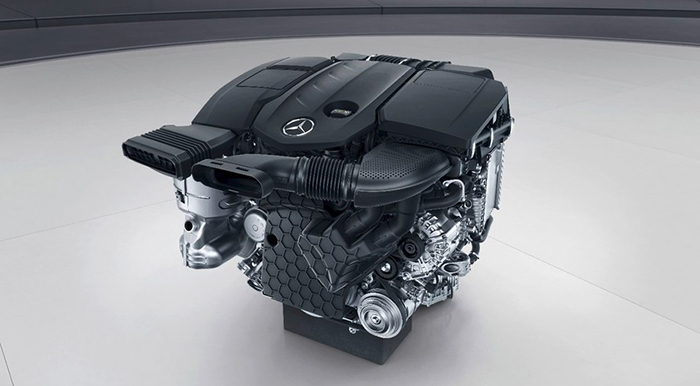
Mercedes-Benz has recently made a big announcement that it is equipping its new E-Class E 220 d with a new four-cylinder diesel engine, marking the debut of a family of powerful all-aluminum four cylinder engines that is set to proliferate throughout Mercedes’ lineup of cars and vans in different outputs and in both transverse and longitudinal configurations.
The premier German automaker believes that internal combustion engines have a bright future alongside electric and hybrid powertrains in the move towards more sustainable mobility, and that cleaner, more economical diesel engines are a core part of this vision. This is why the all-new OM 654 engine that will debut as the E 220 d in the new E-Class delivers NEDC combined consumption of only 3.9 l/100km (60 mpg) and CO2 emissions of 102 g/km, which is a reduction of about 13 percent compared to its predecessor, the OM 651. This is controlled while enhancing power output to 143 kW (192 hp) from 125 kW (168 hp).
This is huge as the outgoing OM 651 is the most-produced engine in the history of Mercedes-Benz. Hence, the new engine will find a new home in all of the vehicles in which the OM 651 is currently featured, including the S-Class, V-Class and A-Class models as well as the high-selling Sprinter van.
Furthermore, the E 220 d also displaces 47.5 fewer cubic centimeters per cylinder than its predecessor, comes with a shorter stroke and smaller bore, and cranks out more horsepower (195 hp vs 170 hp) with the same torque (400 Nm, 295 lb-ft). Its compression ratio is slightly lower (1:15.5 vs 1:16.2) and it is also lighter (168 kg vs 199 kg/370 lb vs 439 lb), while meeting stringent Euro 6 emission standards.
According to Mercedes, their goal was to design an engine that is both excellent in efficiency and that could offer broad variance without heavy modification. Thanks to the new engine’s compact dimensions that enables more flexibility in adaptation to different uses. With an exhaust after-treatment incorporated into the engine itself rather than a separate on the chassis, the design becomes more flexible.
This will be the first all-aluminum four-cylinder diesel engine from Mercedes-Benz, which the company claims has better NVH (noise-vibration-harshness) and lower noise levels than its predecessor. Efficiencies were also added thanks to the next-gen in common rail injection and a 25 percent reduction in internal friction loss, mainly because of Nanoslide coating of the cylinders and an offset crank assembly. The difference in heat expansion between the aluminum crankcase and steel pistons was used in reducing friction in the engine.
The new engine also enables less intricacy in manufacture and variance. Its modular and compact design makes it easily configurable to meet any of the more than 1,000 country- and region-specific emissions and technical requirements without reengineering it entirely or its major components.
Mercedes-Benz will reportedly start production of the new engine in the second quarter of this year and it will start appearing in vehicles later in the year as its predecessor is phased out.